The microcompartment railcar for competitive long-distance railcars
Short introduction video
Comprehensive explanation video
Image gallery
Which body measurements and other dimensions had been assumed?
Have tall or more corpulent passengers to pay more as they need more space?
How many luggage can be accomodated in the compartment or in the railcar?
Why is the legroom so low and so narrow compared to the head end of the berth?
Shall all conventional couchette and sleeping cars be replaced by microcompartment cars?
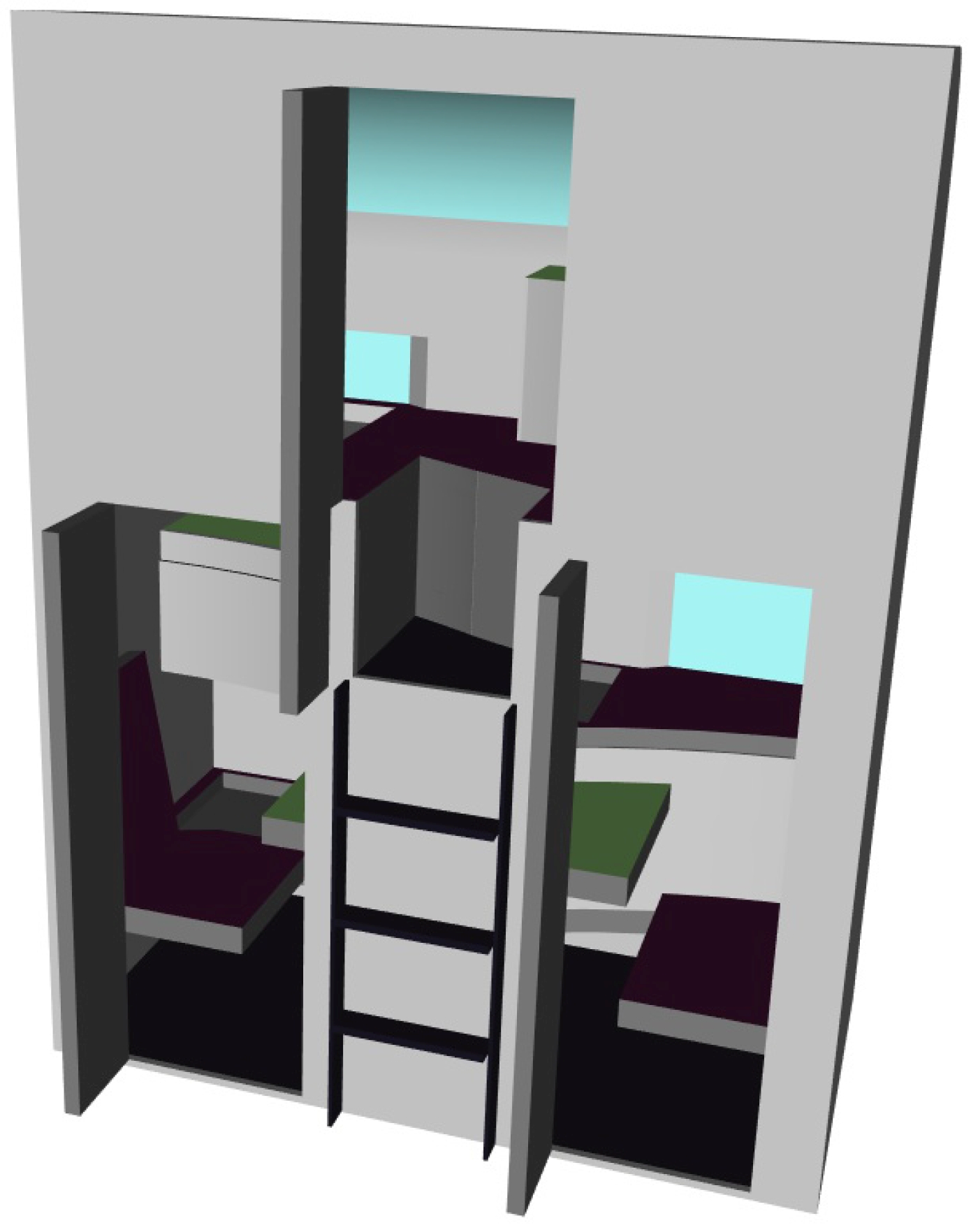
Is it practical that some compartments can be accessed only by a ladder?
Isn't it inconvenient if passengers can't stand upright in the compartment?
Why is there a need for emergency exit windows?
For my taste, that's all too cramped and inconvenient. Didn't you exaggerate the passenger density?
I don't need single compartments, I prefer spacious compartments and I like the conversation with other travellers.
Has the railcar enough toilets and washrooms?
Shall the microcompartment railcars be operated with or without a conductor?
Why is your draft based on an existing railcar type?
Why did you consider the existing window spacing in the side walls although there are new roof windows necessary?
Shall the new overnight and long distance trains be high speed trains?
For longer journeys, passengers can interchange between overnight and highspeed trains, so why should there be a need for very-long-distance trains?
Are there enough free train paths and capacity on the railway network for new very-long-distance trains?
Do we really need new train interior solutions or would air traffic taxation or better financing of rail services be more important?
Shall the new long-distance trains and microcompartment cars be operated by private or public railway undertakings?
Isn't such a wide variety of compartment types too complicated for sales and marketing?
Is the microcompartment railcar barrier free?
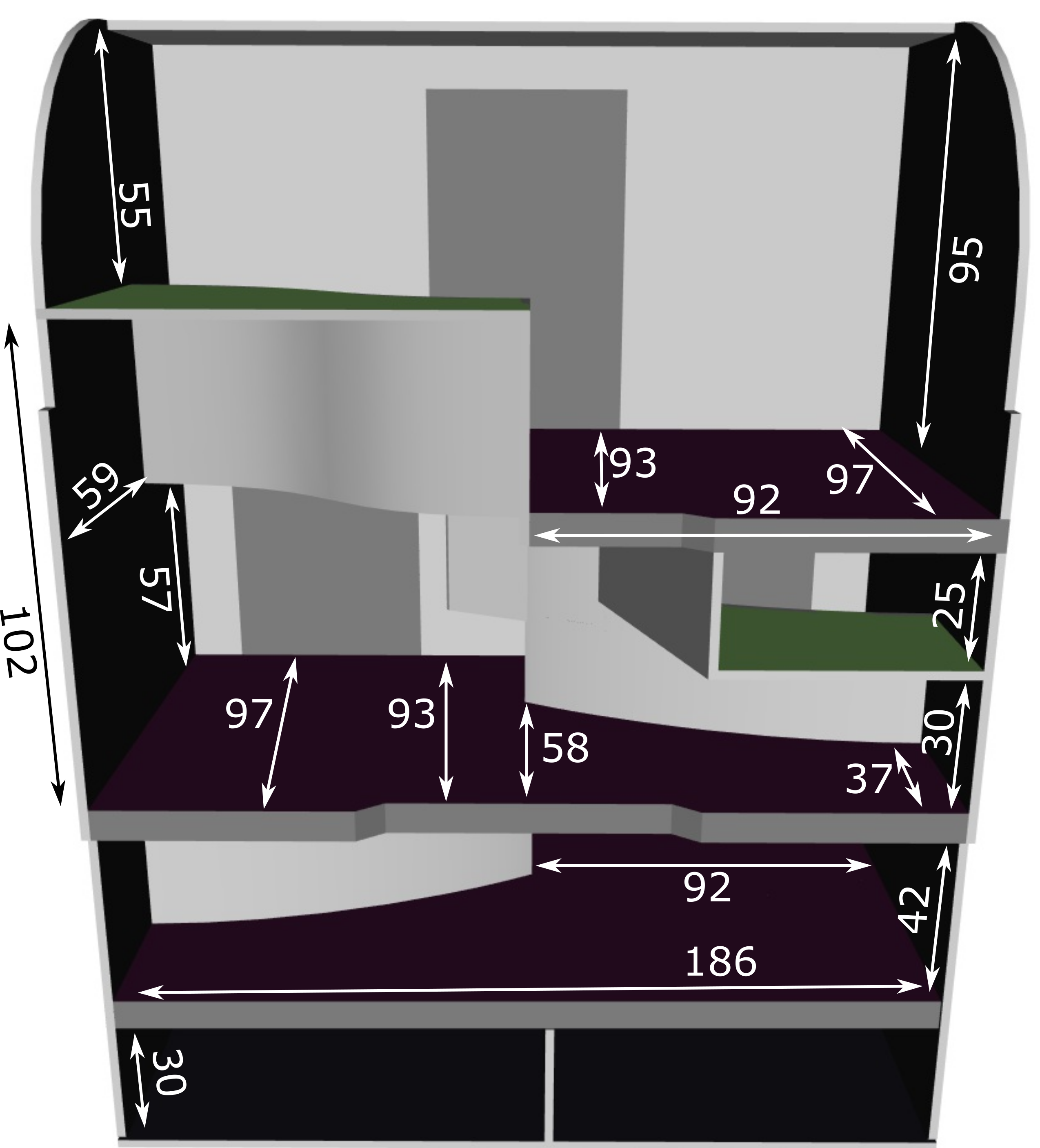
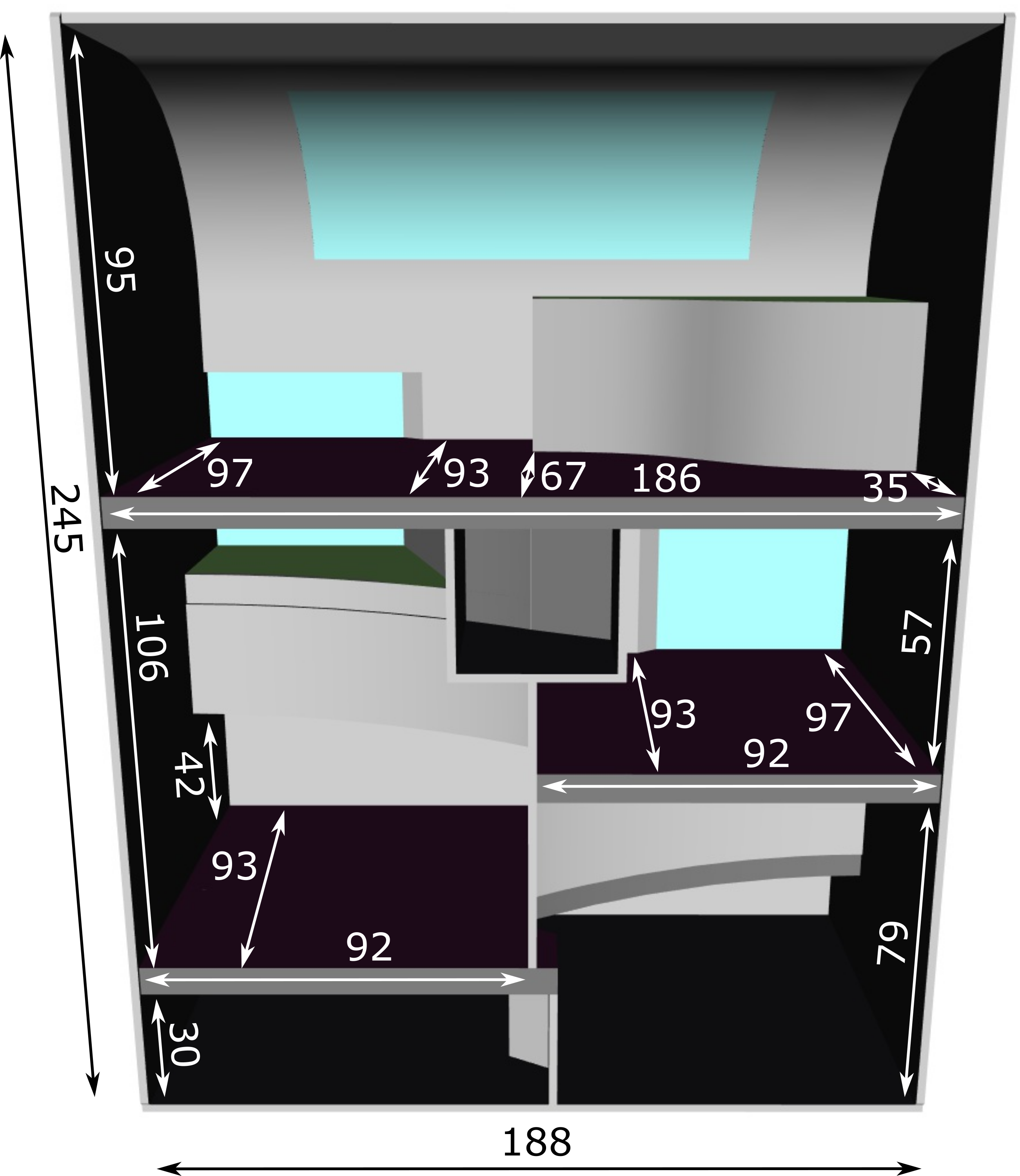
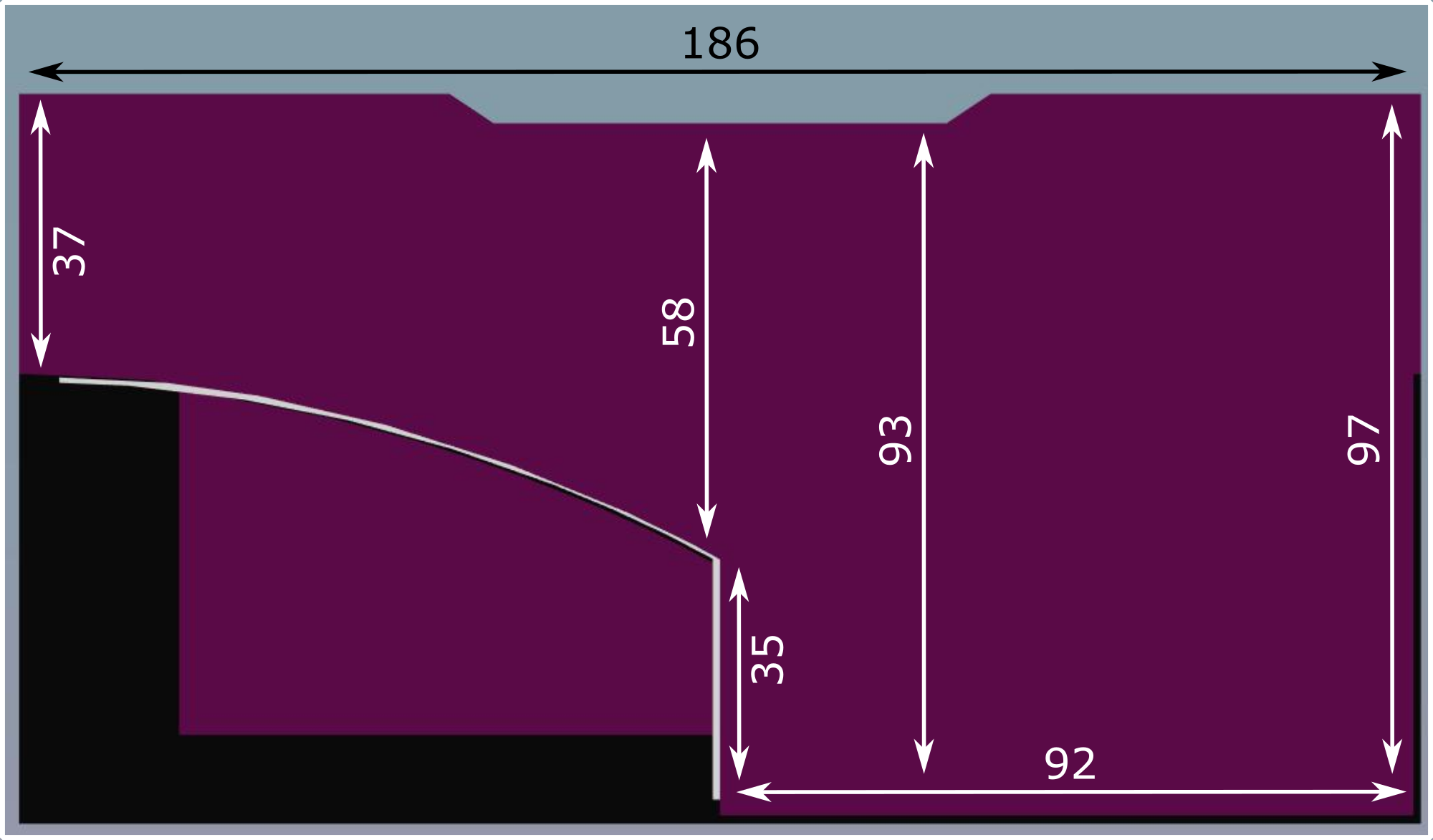
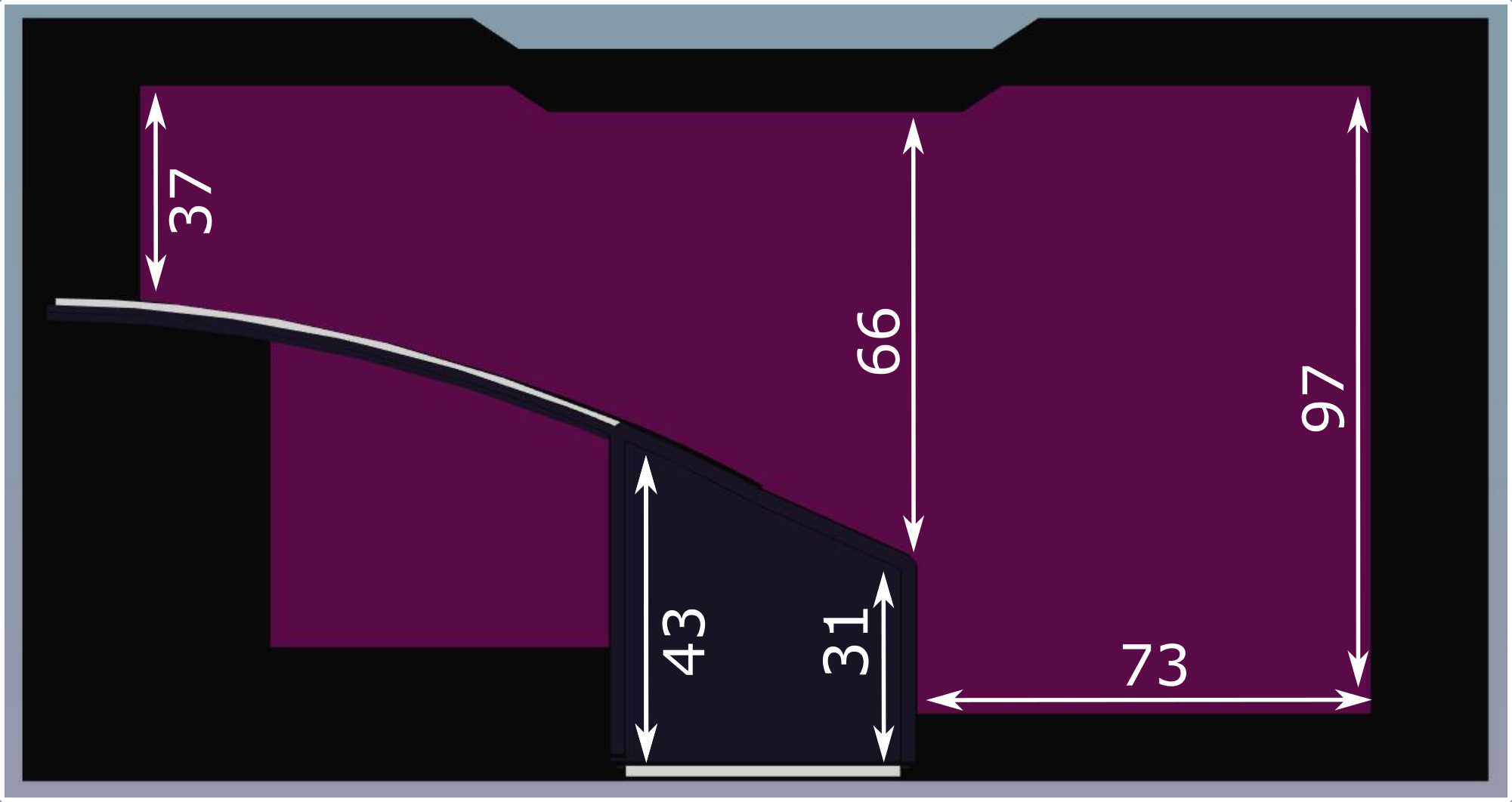
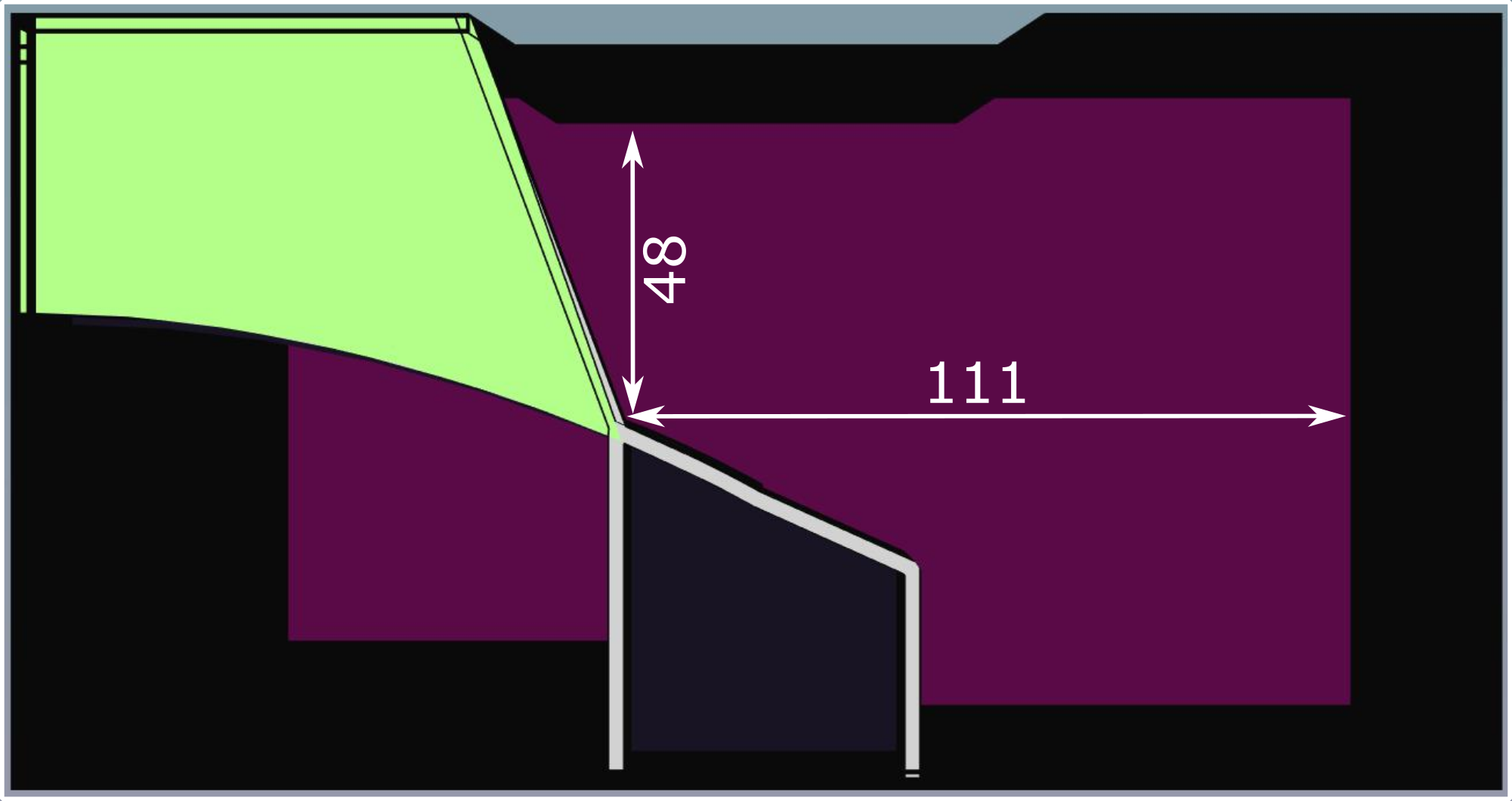
Which body measurements and other dimensions had been assumed?
- Body height in sitting position: 96,5 cm
- Body height in standing position: 185,5 cm (only relevant for extended compartments)
- Hip width in sitting position: 46 cm
- Hip width lying on one side: 42 cm
- Feet length 30 cm, with shoes 36 cm (corresponding to European shoe size 46)
- Part of the railcar length usable for compartments (between the toilets): 20,9 m
- Outer width of the railcar: 282,5 cm
- Thickness of outer walls: 6 cm
- Thickness of windows: 2 cm
- Thickness of vertical and horizontal partitioning walls: 2 cm
- Thickness of seat and berth padding: 5cm (under load compressed down to 3,5 cm)
Because of the limited total inner height of the railcar, a compromise between padding thickness and height above the seats is necessary. Optimization in detail is possible e.g. by thicker paddings in the middle compartment, by thicker padding at the head end than in the legroom or by gaining a bit of inner height through optimized ceiling covering.
Have tall or more corpulent passengers to pay more as they need more space?
It is conceivable to offer the more spacious subcompartments to passengers of larger body body dimensions without surcharge, although this would require at least rough inspection of eligibility. In any case, it would be more expensive for all passengers, if all compartments would be designed for the maximum body dimensions leading to much lower passenger density.
How many luggage can be accomodated in the compartment or in the railcar?
Space for luggage is provided below the lowest seats and berths (about 30 cm height) except the legroom in sitting position plus above 195 cm that part of the space above the corridor, that is not required for the entrance to the upper compartments. Furthermore, passengers can place smaller items during the day on the foot end of the berth and during the night in the legroom of the sitting position. This means already more luggage space, than in a 6-berth couchette car. In the area of the emergency exit windows there are additional 8 lockers for bulky luggage of about 50x60x80 cm.
Why is the legroom so low and so narrow compared to the head end of the berth?
Similar to sailing yachts and small caravans, the microcompartment car takes the advantage of smaller width and height requirements around the passengers' feets in order to give passengers the choice between sitting and lying position despite the high passenger density of the railcar.
Shall all conventional couchette and sleeping cars be replaced by microcompartment cars?
If in some years there will be for example three times as much overnight trains as today, two out of three carriages could be microcompartment railcars and the remaining third could be conventional couchette and sleeping cars.
Is it practical that some compartments can be accessed only by a ladder?
Hopefully, for a third of the passengers this will be acceptable, as the middle and upper berths of conventional couchette and sleeping cars, but also the upper capsule compartments can only be reached by a ladder too. The lower seats and berths as well as the middle berths of the microcompartment railcar are accessible without steps.
Isn't it inconvenient if passengers can't stand upright in the compartment?
I don't think so, because in an automobile or a minibus, but also in the upper floor of a (continental) double decker bus passengers can't stand upright neither. Passengers can take a walk on the corridor at any time during the journey. Also capsule couchette compartments do not provide enough inner height for an upright standing position.
Why is there a need for emergency exit windows?
Even if it wouldn't be compulsory for fire safety regulations, emergency exit windows that are accessible directly from the central corridor increase subjective safety. Direct lighting and a view outside improve the spatial feeling compared to a central corridor without natural light. For my taste, that's all too cramped and inconvenient. Didn't you exaggerate the passenger density?
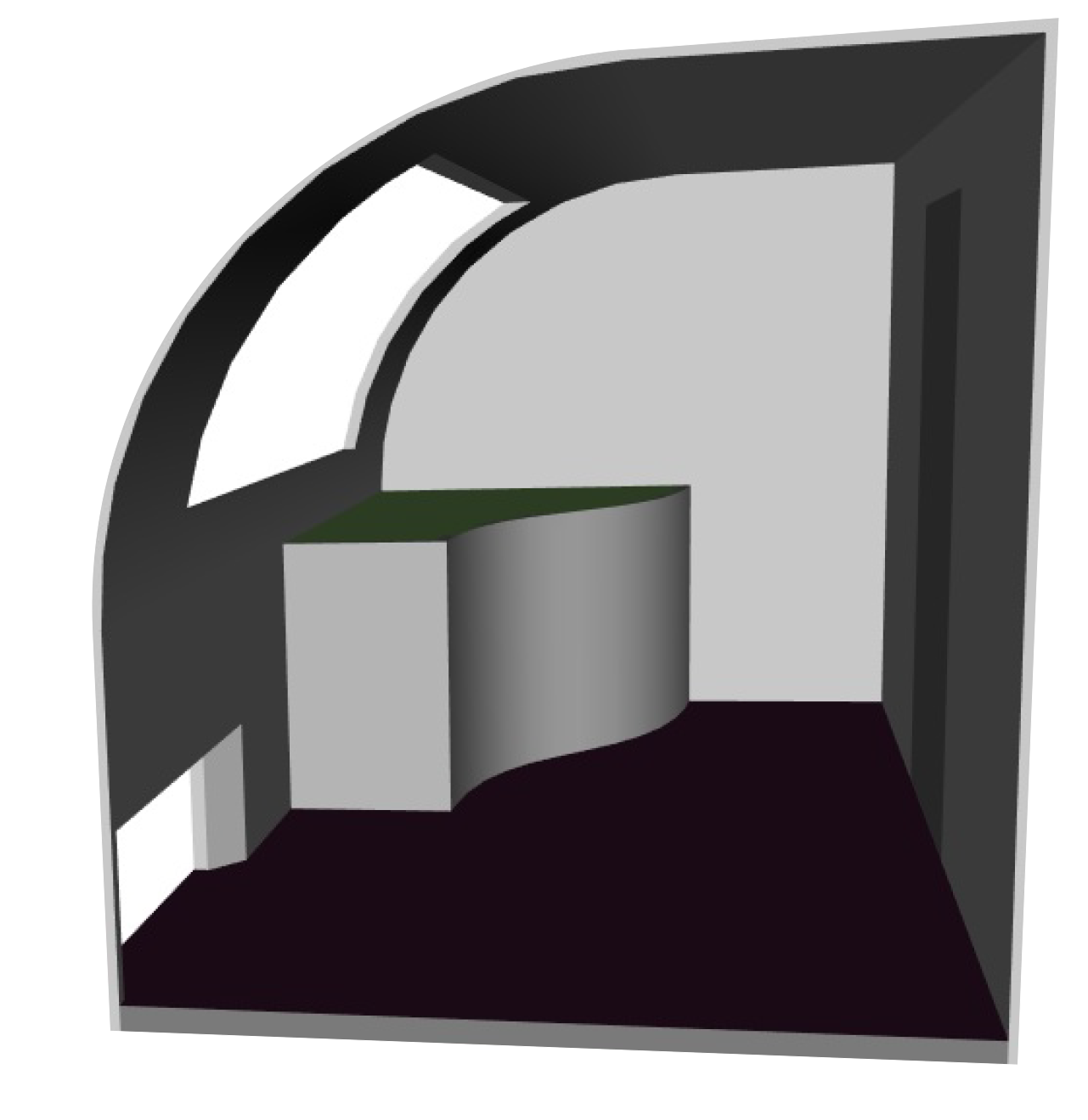
A part of the video about the lifesize model of the lowest subcompartment in the night configuration is sometimes misunterstood: Not the whole compartment has such a low ceiling, just a part of the sleeping area. The part in front of the red cardboard and to the right of the black cardboard has a free height of 105 cm above the berth resp. seat level.
Apart from this, that's a question of individual preferences, willingness to pay and available alternative solutions. Of course, the microcompartment car can't provide the same sleeping comfort as a usual bed at home or in a hotel, but in a vehicle, space means much more effort, than in a building. Anyway, the microcompartment allows various sleeping positions whilst in a bus or a seated railcar you just can try to sleep in one single seating position. In addition to conventional couchette and sleeping cars which shall be still used, the microcompartment railcar is an offer for passengers travelling alone or in pairs that do not have the willingness to pay for a sleeping car but prefer undisturbed travelling without strangers in the compartment. I suppose, that decision makers in the railway sector tend to underestimate these target groups as their social environment consists rather out of people with a rather higher willingness to pay for comfortable and environment-saving journeys.
I don't need single compartments, I prefer spacious compartments and I like the conversation with other travellers.
For passengers like you, there will still be conventional couchette cars. In order to make the train an alternative to the airplane, we have to focus on those target groups, who do not use overnight trains until now, not on existing night train users. After many talks about night trains, I have the impression that it is inacceptable for many people to sleep in a compartment together with other passengers. Also during daytime, people often feel either disturbed by other passengers, or they feel restrained in order not to disturb the others, so they can't enjey or use their travel time. Business travellers or people that commute several times per year between their place of work and their home country probably have different preferences, than relaxed, chatty holidaymakers.
Has the railcar enough toilets and washrooms?
Some couchette or sleeping cars have more toilets or extra washrooms per number of passengers but there are also such with only two lavatories per 54 berths. A high demand of toilets and washrooms results from night train operation over relatively short distance with one dominant station of origin and one dominant destination, so nearly all passengers get up and prepare for arrival at the same time. Therefore, very-long-distance trains serving more than one destination would need less toilets per railcar, furthermore toilets would be occupied shorter or less frequently as passengers can change their clothes, comb their hair and make themselves up in their private microcompartment instead of the toilet or the washroom.
Shall the microcompartment railcars be operated with or without a conductor?
For the purpose of objective and subjective security, overnight trains need more trainstaff than trains running during daytime, but single passengers compartments reduce the need for surveillance and assistance, in particular if they can be locked from outside too, e.g. by a smartcard or a QR code. Whether there shall be a conductor in each railcar or not depends on the detailed service concept (Bed linen, breakfast or other meals...) and the work scheduling (frequency of personnel changes along the train run).
Why is your draft based on an existing railcar type?
Classical long-distance railcars according to the UIC-Z-Type are still in significant numbers available on the second-hand market and also as new-built carriages they can be procured much faster and cheaper, than newly designed railcars of different geometry or even a new electric multiple unit. Nevertheless, modernized long-distance carriages fulfil the requirements of modern and attractive train operation as air condition, closed WC and a top speed of 200 km/h. In particular for the start of new business models in the market segment of overnight and very-long-distance trains, the modernization of second-hand carriages means by far less risk, than the development of a completely new railcar type. Anyway, it would also be possible to design a new highspeed-EMU equipped with microcompartments.
Why did you consider the existing window spacing in the side walls although there are new roof windows necessary?
I suppose, that the side walls are more important for the stability of the railcar than the roof and it should be easier to find suitable positions for larger or smaller windows in the roof than to shift existing window axes. Without a roof window, the upper compartment would have only a very small window directly above the seat resp. berth surface.
Shall the new overnight and long distance trains be high speed trains?
The principle of microcompartments could be applied in real high-speed trainsets as well as in more conventional long-distance trains with a top speed of 200 km/h. Up to 200 km/h, existing long-distance carriages could be refurbished or new railcars with similar geometry could be manufactured. Design and manufacturing of a suitable high-speed train could be significantly more effort. A high speed train would have more range within the same travel time, but it would be more expensive and less versatile concerning approval in various countries.
For longer journeys, passengers can interchange between overnight and highspeed trains, so why should there be a need for very-long-distance trains?
Compared with a direct very-long-distance train, a journey with interchange in the morning and/or in the evening has the following disadvantages:-
Interchangeng means always certain discomfort, in particular with much luggage on stations, that are unfamiliary for the passenger.
- Under conventional circumstances, the price for travelling by train increases more or less proportionally to the distance, in contrary to airplane tickets, priced rather subproportionally to the distance. Because of this, it is very important to decrease costs per passenger-kilometer through a reasonable passenger density and good utilization of rolling stock nearly around the clock. The combination of overnight and high speed trains means more, and more expensive rolling stock as in case of a direct train with universal interior and a maximum speed of 200 km/h.
- A part of the efficiency gained by the universal rolling stock is used for a little lower passenger density compared to daytime trains, facilitating the unique advantage of private single compartments, facilitating optimal use of the travel time.
- Interchanging always means a certain risk of missed connections because of delays. In case of long-distance travel this is either very inconvenient for the passenger, or it means additional costs for the railway undertakings because of compensation and standby capacities in alternative trains for passengers who missed their intended connection. Eventual buffer times for interchanging from unreliable overnight trains often compensate the travel time advantages of the high-speed train used afterwards.
- The trains running during daytime are already well frequented by daytime travellers, a big number of passengers interchanging from overnight trains would lead to overcrowding or a high price level in trains departing in the morning.
Are there enough free train paths and capacity on the railway network for new very-long-distance trains?
Parts of the european railway network are indeed highly utilized and it can be difficult to reconcile new long-distance-trainpaths with existing regular-interval services (regional and long-distance) without disadvantages as speed reduction, loss of connections or irregular intervals. In contrary to the sometimes quite non-constructive disputes between open-access operators regarding conflicting train paths, the following solution approaches can be helpful:
-
In long-distance services as well as in regional and suburban services, not all regular interval schemes cover the whole day, but there are certain gaps: Some long-distance services run only every two hours, but the surrounding regional services follow an hourly system, so there is a gap every second hour, that could be filled by a new long-distance train. Commuter services often run more frequently during peak hours, e.g. every 15 minutes instead of every half hour. Therefore, the ideal overnight train path arrives in one major city arond 6:00 and in the next one after 8:00 as the most significant peak in commuter traffic is between 6:00 and 8:00.
-
On some sections, new very-long-distance trains could replace existing trains, if tickets are mutually accepted and the total capacity is sufficient. In order to avoid problems with the circulation of vehicles, such a replacement should ideally take place in that section, where the new trains of both directions meet each other, so two existing trains of opposite direction are replaced at the same time.
-
The new very-long-distance trains could omit some stops, that are regularly served by conventional long-distance trains, perhaps by the use of bypass lines. In major cities with several stations, the new trains can use less frequented stations than the main stations of the conventional long-distance trains. To moderate extent, longer travel times can be accepted, e.g. if the new train must be overtaken by a regular long-distance train or it has to adapt to the speed of stopping trains in some short suburban section with dense commuter traffic.
-
Last but not least, for trains with a travel time of 12 hours and more, a lower standard of punctuality can be accepted, as long as the timetable information system shows reliably the earliest expectable departure and the latest expectable arrival. Airplanes also have less punctuality than trains. If the punctuality standards for these trains are lowered and the new very-long-distance trains do not run every hour, but only several times per day, the infrastructure manager can apply more optimistic parameters for timetabling, e.g. with shorter headway or scheduled use of the opposite track.
The described degrees of freedom had been used in the past and are still used in order to facilitate isolated trains beyond the usual regular-interval timetables: Sprinter or direct trains running only one or two times per day, relief trains on travel peak days or charter trains for tour operators. A further shift from air to rail transport will anyway require improvements of the railway network, in case of new very-long-distance services as well as in case of shorter intervals for conventional trains during the daytime.
Do we really need new train interior solutions or would air traffic taxation or better financing of rail services be more important?
The more and the sooner taxes on air travel will be increased, the better and more public money for railways would be obviously useful. The microcompartment railcar ist not contradictory to such politicital measures, but it facilitates at same circumstances more attractive rail travel for more passengers. So some shift from air to rail travel could be achieved even in case of rather unambitious climate policy and a more restrictive policy against air traffic will be more popular, if long-distance trains are perceived as an acceptable alternative.
Shall the new long-distance trains and microcompartment cars be operated by private or public railway undertakings?
It would be desirable, if the microcompartment car and higher taxes for air travel would make many new long-distance trains profitable without direkt public funding, so the expansion of the long-distance rail services would not be limited by available public funds. Regardless whether the trains are operated by public or privately owned companies, timetable planning and train path allocation should happen more constructively, than currently in some european countries with a high share of open-access services.
Isn't such a wide variety of compartment types too complicated for sales and marketing?
With an appropriate booking and information system, that does not list all classes, but asks for the group size and certain preferences and preconditions first, the variety of subcompartment types should be manageable. Ferries usually also have many different cabin types and hotel booking engines handle a wide range of room amenities.
Is the microcompartment railcar barrier free?
No, at least one conventional railcar with barrier-free equipment per train is necessary in order to make the train as a whole barrier-free.